
PRACTICE RESURRECTION
Remembering The Great Ones - 'Steadfast belief in the face of credible doubt.'

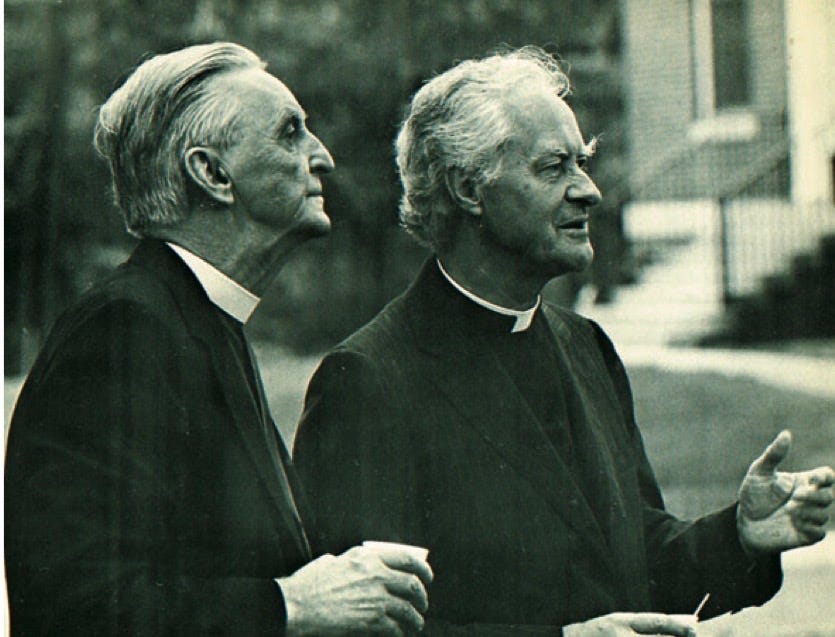
Dr. Albert Mollegen and Dr. Cliff Stanley
“...ask questions that leave no answers. Plant sequoias and call that profit, then laugh and be joyful and go with your love to the fields. Rest your head in her lap. Practice resurrection.”
Wendell Berry - Mad Farmers Liberation Manifesto
There is a framed, black and white image on the knotty pine wall beside my desk that has travelled with me now for almost 30 years. This photograph, taken by a student of my father’s by the name of Nick White (Virginia Theological Seminary, ’73), may be the only surviving relic of my adolescence, a scratched artifact that against all odds has survived the reckless turbulence of adulthood and the interminable wanderings that have marked my journey to this quiet and reverent place on the high mesa beneath a canopy of cottonwoods and poplars in Taos, New Mexico.
White’s portrait of Cliff Stanley and Albert Mollegen is a rendering of two giants in the late autumn of their lives, paragons of intellectual curiosity who embodied the fraught paradox of Christian faith: ‘steadfast belief in the face of credible doubt.’ Their silver manes are swept back from high furrowed brows, those laboratories of social and theological insight, faithfully frozen by light and optics in a silver nitrate emulsion that grips them forever in a moment of childlike wonder. It is a magical thing, this image. It is the visual transmission of all things soulful and sacred, a celebration of our nearly infinite capacity to marvel at the human experience right up to that moment when they drop us into the box.
What I have come to understand on my own journey, as a photojournalist who has spent the better part of 20 years looking into people’s eyes, waiting for that exquisitely brief moment when my subjects unwittingly reveal to me a glimpse of their souls, is that pound for pound, the language carried in light is as affirming and transformative as any we dare to make with sound. Images endure, loaded with challenging questions constructed of nuance and shadow, enigma and identity. Visual language is the medium of life.
At about the same time Nick White snapped his remarkable image of Stanley and Mollegen, my family was returning to the United States from Mexico City where dad was a professor of Old Testament at the Anglican Seminario de San Andres. One evening in the spring of 1969, he and mom made a momentous announcement at the dinner table: dad had accepted an invitation to join the faculty at VTS, his alma mater,
____________________________________________________________________________
It was in those dorm rooms that I learned that the Great Ones had been close colleagues of Tillich and Neibuhr and Bonhoeffer, a convergence of spiritual horsepower that glazed my eyes and made my brain spin with holy vertigo.
____________________________________________________________________________
and we would be leaving Mexico at the end of summer. I would turn 18 that summer, and as the oldest of their four children I was more than ready to fly from the family nest, but there were complicating factors. For one, our move back to the States happened to coincide with the peak of the Vietnam War. While I was determined to experience the world on my terms, my new draft board in Alexandria had its own ideas about my catalog of options. So, when I returned from an ill-advised-spur-of-the-moment-please-send money-so-I- can-get-home trip to Europe with the last of my college scholarship stipend, my nearly impoverished father, then in his second semester of teaching at VTS, was, shall we say, taciturn.
That was the spring of Kent State, moratoriums, sit-ins, and huge anti-war marches in Washington D.C., turbulent and exciting times. No campus ( Bob Jones doesn’t count) was immune, seminaries included. Landlocked at VTS, I found myself spending more and more time with students in the dorms. There were always heated discussions underway in somebody’s room. Camus, Merton, Tillich, Sartre, Kierkegaard. These
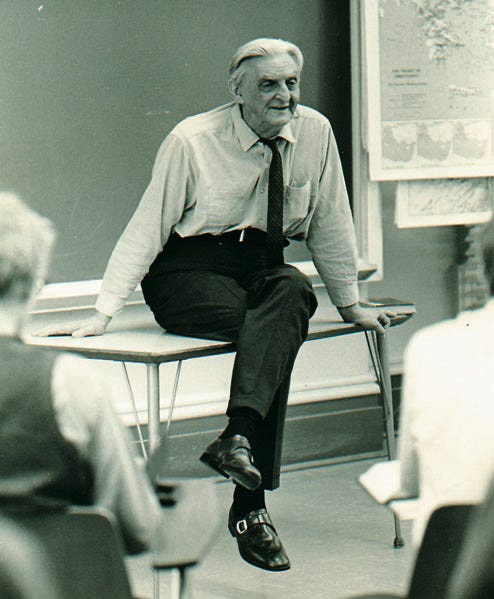
Albert Mollegen, presiding over theological chaos in the classroom
men and their thinking shaped the currency of our exchange, and as the evenings wore on the discussions inevitably turned to the Great Ones. To Stanley and Mollegen. It was in those dorm rooms that I learned that the Great Ones had been close to Tillich and Neibuhr, a convergence of spiritual horsepower that glazed my eyes and made my brain spin with a kind of holy vertigo. The inimitable Paul Sorel once told me a delightful parable about these associations, one that twisted his rubicund face with cackling mirth. Tillich and Mollegen were out walking at Union Seminary one afternoon when Reinhold Neibuhr happened by on the far side of the street. Neibuhr suddenly stopped and bent over to pluck something from the grass, a four leaf clover, which he held up to the sunlight with obvious satisfaction. “Damn pantheist,” Tillich muttered, as he and his young protege moved on without missing a beat.
___________________________________________________________________________
As I listened to his final lecture from that empty hallway I suddenly had a sense that I was not alone. Startled, I blinked and looked up, following the shadow on the floor up a pair of legs to the imponderable face of Dr. Mollegen. He towered over me and held a finger to his lips. Then we smiled at each other and listened as Stanley’s final words were punctuated by a roar of applause.
__________________________________________________________________________
The intellectual vitality in the dorms could become wildly animated on any given night, yet the accidental mention of the Great Ones would suddenly dilate a roomful of eyes with free floating panic. The word “Stanley,” uttered by itself, with no attending modifiers, could send shudders of dread through a silent room full of grown men. That spring, one poor soul had courted eternity in purgatory when he dared to challenge Mollegen on the nature of “spirit.” As the Great One walked slowly toward the windows, rubbing his forehead between his fingers, the unwitting student no doubt glimpsed his life flashing before his eyes. Molly, as he was known, finally lifted a finger to the sky and announced: “Young man, you cannot put a leash on a tree and walk it to the A & P!” The ovation, it was said, lifted a flight of mallards on the reflection pool across the Potomac. So weeks later, when four students were killed at Kent State University in Ohio by national guardsmen, and the nation descended into paroxysms of anguish, it came as no surprise to the students at VTS when Molly’s classes were suddenly cancelled. Cooler heads on the Ohio campus had turned to Albert Mollegen in their hour of crisis to reassure them, and the students at Kent State, that God’s love cannot be vanquished by human acts born in fear, and His spirit will always prevail over adversity through the loving acts of the faithful.
Being a bold and curious 18-year- old, and knowing what I knew (and not knowing what I didn’t), it was more than I could bear to walk past Stanley’s house in the evening and see the light on inside behind the tall panes, and know the Great One was in there alone, with all those rarefied thoughts rumbling around in that busy forehead. I don’t recall what might have prompted me, but one evening I screwed up my courage under those high white columns on the Stanley portico and lifted the brass knocker. And let it drop.
The jarring clang of brass striking brass was the end of one thing in my life and the beginning of something else. A mark, a line, a note separating childhood from adulthood. Dr. Stanley not only let me into his home, into his solitary and fabled world, he graciously opened the doors to his heart and his mind. I visited him often that spring, and we became good friends, as close as we could be and still be separated by 45 years of age and a lifetime of experience. Despite the obvious chasms, it was clear to both of us that we were animated by the same questions, the same tantalizing and confounding ontological inquires, the same daunting paradoxes.
In my special memories of those evenings, the two of us are standing at the sink in his kitchen, washing and drying his dinner dishes, talking about Kierkegaard and Miguel de Unamuno and Tillich and Bonhoeffer. Perhaps, through me, Cliff Stanley was once again re-experiencing a closeness with his own sons, of whom he was very proud. He told me one evening, in that same kitchen, that he once asked his son, David, to consider a life in theology. Once spoken, he would never mention it again. True to his own journey, David followed a career in the law.
“I’ve been blessed with a life of intellectual inquiry,” Dr. Stanley told me one evening. “I wouldn’t trade it for anything, but after it’s all said and done, when you spend your entire day with your head in the clouds, none of it means anything unless you brush your teeth and feed the fire and cook your food and go to the bathroom. Without those things, we forget who we are.”
___________________________________________________________________________
The students had left the front two pews completely empty. Pointedly empty. Apart, alone, Molly genuflected and turned into the first empty pew and sat down. Right in the middle. Right in front of the pulpit, a solitary figure floating in a space that he filled to capacity .
___________________________________________________________________________
As his storied career at VTS drew to a close, it was quite impossible for the seminarians and faculty members to imagine a world in which Stanley was not teaching his class on the Resurrection. I’m certain he never knew it, nor did my father nor anyone else (until later), but I would not have missed those final classes for anything. I sat on the floor in Aspinwall Hall just outside the door to Stanley’s classroom as he delivered his final lectures. I will never forget the sound of his voice, or knowing that I was hearing greatness, and being awed by the reverence and passion as he spoke from the point-source of his being on the meaning of the Resurrection. I can see the animation in his great silver eyebrows as clearly as I hear the authority in his words. As I listened to his final lecture from that empty hallway I suddenly had a sense that I was not alone. Startled, I blinked and looked up, following the shadow on the floor up a pair of legs to the imponderable face of Dr. Mollegen. He towered over me and held a finger to his lips. Then we smiled at each other and listened as Stanley’s final words were puncutated by a roar of applause.
I’m not sure how it happened. Fate maybe. The poetics of grace, certainly. As though it were yesterday, I recall the Wednesday evening that spring when Cliff Stanley was to deliver his final sermon from the chapel pulpit. Wednesday evening chapel was a hallowed tradition at VTS that had been celebrated, without interruption, since the Seminary’s founding in the early 1800s. After dinner, my father and I started across the campus together and were suddenly joined by Dr. Mollegen. ‘Molly', and The Great One was known, was in great spirits, though in retrospect his animated nervousness was probably a groom’s anxiety. This was it. His life long friend, the paragon of systematic theology that was Cliff Stanley, was passing the torch. The angular, magic hour light that flooded across the campus was radiantly amber as students streamed across the lawns toward that familiar brick and glass building. Everyone was there. Dean Woods, Fitz Allison, Jack Goodwin, Jim Ross, Murray Newman, Paul Sorel, et. al., all points of light that shaped a brilliant constellation. Who would dare miss it?
As the three of us entered the front doors everything about the chapel was reassuringly familiar, the bitter sweet smell of old wood, floorboards creaking underfoot, the dank and holy shadows. Y et something subtle, something imperceptible, was out of balance. I followed my father into a pew as Dr. Mollegen continued up the aisle. All the way to the front. Then I saw it. I elbowed my father and nodded toward Mollegen. The students had left the front two pews completely empty. Pointedly empty. Apart, alone, Molly genuflected and turned into the first empty pew and sat down. Right in the middle. Right in front of the pulpit, a solitary figure floating in a space that he filled to capacity .
I don’t recall what Stanley said that evening. The visual image that is frozen in my neurological hard drive is the image of Mollegen sitting with his arms arched over the back of the pew as Stanley delivered his final sermon from the pulpit that had been their home for decades. It was as though the two of them were alone in the world, together, right where they had always been, Stanley preaching to Mollegen, Mollegen preaching to Stanley, illuminated by the wonder of each other and some compelling insight one or the other had just glimpsed in the human spirit. Just as they are in the picture on my wall.
The last time I saw Cliff Stanley was on Easter morning, two years later, in the same chapel. As usual, there was standing room only in a sea of pastel hats. Communion was interminably long, as usual, but the spirited recessional made it all seem worth the wait as people jumped to their feet. The sea of hats squeezed through the doors as one, creating a bottleneck that found me trapped off the center aisle. Impatiently awaiting my escape, I saw Dr. Stanley’s silver mane of hair bobbing down the center aisle, a head taller than everyone around him.
He had the most sublime smile on his face, a faraway look that came over him whenever he talked about Kierkegaard, a subject that made his eyes focus on a familiar point beyond infinity. Then suddenly he snapped out of his trance and reentered the heady confections of the moment. He looked directly at me, as though he had known all along that I was standing there, and broke into a big smile. His arm shot toward me over the sea of hats and reached for my hand and our fingers clasped across that pastel space.
“He is risen!” he exclaimed, gleeful as a child.
Cliff Stanley had committed his life to celebrating the divine grace that is carried in the belly of that paradox, the confounding and breathtaking possibilities of the miracles concealed within the shadows of the impossible, in the tension between steadfast belief and credible doubt. When our eyes met for the last time, brimming with light, it was as though the awful paradox of the Resurrection, for an ephemeral moment on that brilliant Easter morning, released us both from its fierce embrace. And then he was gone.
*